PACES MRCP UK - Where MRCPians Meet Since 2006

MRCP is well establised as an entry exam for advanced specialist training in many countries including Malaysia. It consists of 3 paper i.e. Part1, Part2(written tests) and PACES. PACES in full means Practical Assessment of Clinical Examination Skills. It is the third part and the candidate is assessed by fellows of RCP. I passed my PACES in 2005. I am glad that many seniors had guided me throughout my preparation for PACES and I wish to share my experiences with PACES candidates via this blog.


Friday, January 25, 2008

Gynaecomastia in PACES

This is a man !

The most important tool in PACES is Inspection.

However to differentiate a pass from a fail involves preparing for the exam and of course luck which is difficult to change except by praying hard for the exam. For the former, pls remember that the time for the cases are short and most that comes out from our mouth has been prepared before the exam

So, if you see this picture, always remember which station you are

Nobody will miss the gynaecomastia in the above man

Station 1 : Abdomen - Cirrhosis of liver

Station 1 - Resiratory - Bronchogenic carcinoma

Station 3 : Cardiovascular - Drugs (spironolactone/digoxin)

Station 3 : Neurology - Myotonic dystrophy

Station 5 : Endocrine - Klinefelter's syndrome

I know there are other causes of gynaecomastia such as adrenal... but my mentor (eMRCPian) once told me, always think PACES way when you are going for a PACES exam !!

So, the above patient has gynaecomastia from Klinefelter's syndrome, look for other signs of Klinefelter.

Written by Wuchereria

Labels:

Thursday, September 27, 2007

Let's Stick To Our Basic!

Spotted the post of palmdoc in MMR regarding Eternal Clerking. I absolutely agree with palmdoc. I still remember my professor in UM once said, an in-depth clearking and detail examinations are able to make >95% of the clinical diagnosis. We only need investigations to confirm the provisional diagnosis.

Undoubtedly, the advancement of modern medical diagnostic tools have changed the way of our practice. Sometimes, we are over dependent on these new gadgets until we forget the basic skills that we learned during our undergraduate days. In addition, defensive medical practitioner also rely on investigations to self-proof from medical legal issues.

All MRCPians, let's not to forget our eternal basic! I am sure we all can make an accurate clinical diagnosis in 13 minutes of detail history clerking and 5 mins of system examination.

All the best for your coming PACES in Oct/November!

Here is a great melody kudos on the essentials of clinical skills. Cheers!

Labels:

Sunday, February 12, 2006

"4C rule for PACES"

Many seniors always remind me that PACES is a showmanship about your clinical skills. As a PACES candidate, you need to acquire the skill of "bluffology" in order to convince the fellows that you can join them as a member in RCP. However, this is not easily done if your thoughts are disorganized especially during that stressful important exam day!
One of my senior actually taught me to think and summarize the findings according to 4C rule.
C: Condition
C: Cause
C: Complications
C: funtional Capacity

Labels:

Tuesday, January 31, 2006

"Weapons for PACES"

PACES is unlike MRCP written tests as it is an assessment of clinical skills. You need to practice, practice and practice! Nevertheless, we still need reference books for guidence. I will list out the books that I used and my comments for each of them.


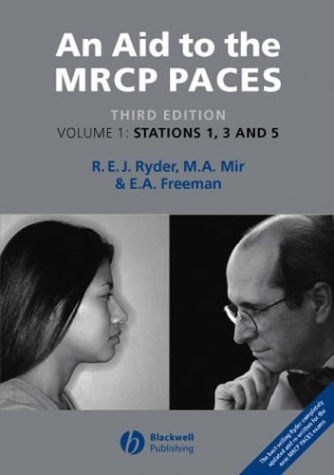
The first book is the silver part of Aid to MRCP PACES by Ryder/Mir. It is essential and you MUST have it while preparing for the PACES. It lists out the most common possibilities under station 1,3,5. Although its does not give differentials for every station, it does give you some ideas to sell your presentation. My advice is to use this book with Baliga plus a lot of bedside practice. It will made Station1,3,5 passable.

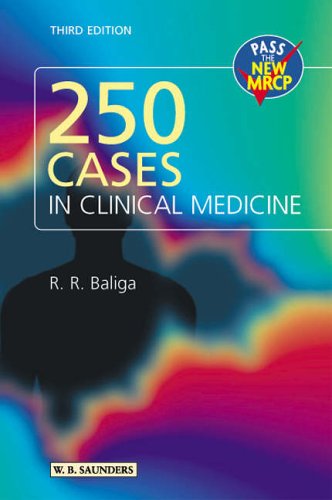
Baliga is a good companion for the silver Ryder. Each case is presented in the form of 'salient' feautures in the history, and the examination findings, followed by a question and answer discussion around the topic which is not done by Ryder. I would highlight that it is the cheapest PACES book you can have as it has a lots of pictures and it only costs less that RM60.


The gold part of MRCP PACES by Ryder/Mir. I would say it is a life saver for someone who has a lack of time or enough UK experience to be comfortable with the system i.e. Malaysian candidates. It elaborates the common themes of communication station e.g. breaking bad news for brain death, withdrawal of treatment and etc. It is helpful before your go for practice or real exam!

These are the 3 weapons that I use for my PACES. What is yours?

Labels:

Tuesday, January 17, 2006

"Strategies of presentation"

  • There are 2 different ways of presentation. The first one is "hit hard" strategy and the second one would be "long story" strategy. There is no hard and fast rule in choosing this 2 strategies. It really depends on your self confidence and comfort in presenting the clinical signs after you gathered the signs.
  • However, I would prefer "hit hard" for station 5 and "long story" for station 1 and 3.
  • "Hit hard" means we present the diagnosis straight at the start followed by the evidences to support it. For example, this is rheumatoid arthritis as evidenced by symmetrical deforming arthropathy involving PIP and MCP with the sparing of DIP. There is swan neck deformity and wasting of small muscle of hands. The joints are not warm/tender and functionaly are limited by the deformities.
  • "Long story" is more applicable for major stations that involve a lots of signs. This style of presentation allows us to present systematically and avoid unnecessary omissions. I would suggest we start from peripheral signs. For example, this man is comfortable at rest. The pulse is...../min and ...collapsing. There is... peripheral signs to suggest IE. He is ...pink...jaundice....cyanosis. The JVP is.....This is a midline sternotomy scar......The apex beat is at......There ...parasternal heave......and palpable 2nd HS . The 1st HS is .........metallic in nature......2nd HS is.......loud. There is ..........signs of HF i.e. basal creps ....ankle edema. In conclusion,the man has prosthetic valve ....which valve and evidence of...........IE/HF/PHT.

Which one do you prefer?

Labels:

"Sing a song"

A PACES candidate must be a good singer. Afterall, it is a show about the skill to be a physician who is thorough and complete in examining patients. So, we need to sing after each examination.
1. Respiratory: I would like to complete my examination by checking the temp chart for any fever, sputum cup and perform a bedside PEFR.
2. Cardiovascular: I would like to complete my examination by checking the blood pressure, temp chart, fundoscopy for Roth spots, abdomen for splenomegaly and urinalysis for RBC & proteinuria.

This applied to other systems as well. So, what is your favourite song?

Labels: